Which vendors have outstanding credits?
Why ask this?
Before closing the purchasing ledger, a buyer needs to know which vendor credits are still owed and how many credits to follow up on.
Start with the sample data
Open source.csv. In the first row of source.csv, Vendor = Lime, Received credits = 4, Promised credits = 7.
What to say
List only the vendors that received fewer credits than promised. Subtract received credits from promised credits and show the shortfall.
Processing time
- Recorded audio to table ready
- 5.01 s
- Transcript to table ready
- 0.38 ms
One local replay from recorded audio through transcription and native table data preparation. Recording time and screen painting are excluded.
See the transcript in the composer

How the canvas produces the result
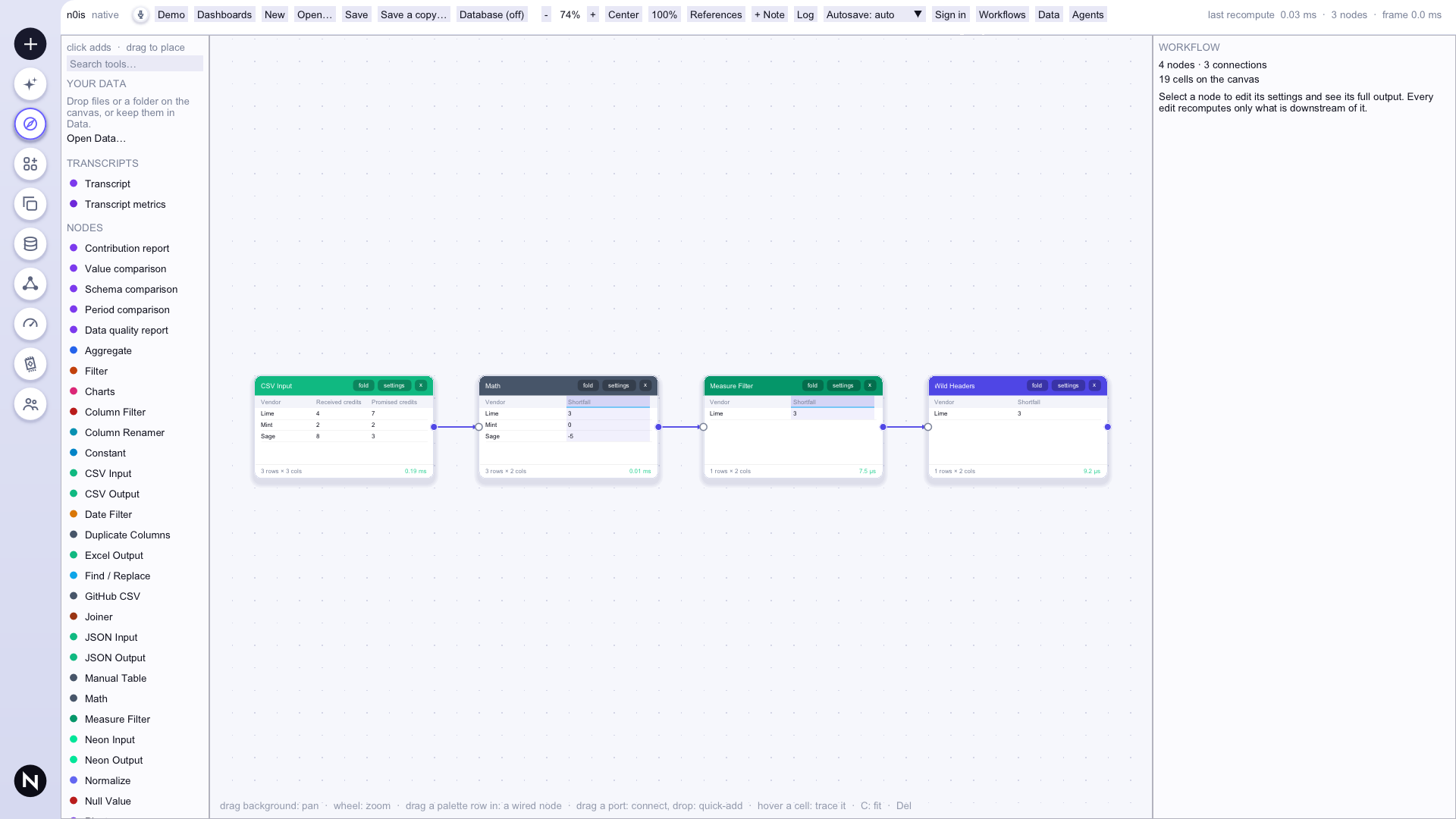
- CSV Input · Read the sample records
source.csv supplies 3 rows. These records are the inputs to the next step.
- Math · Calculate Shortfall
Apply [Promised credits] - ([Received credits]) to each input row. The first row yields 3.
- Measure Filter · Keep the requested rows
The filter uses Shortfall > 0 in keep mode. 1 rows remain including Lime.
- Wild Headers · Choose the output columns
Use keep mode with the regular expression ^(Vendor|Shortfall)$. The output contains Vendor, Shortfall.
The result table
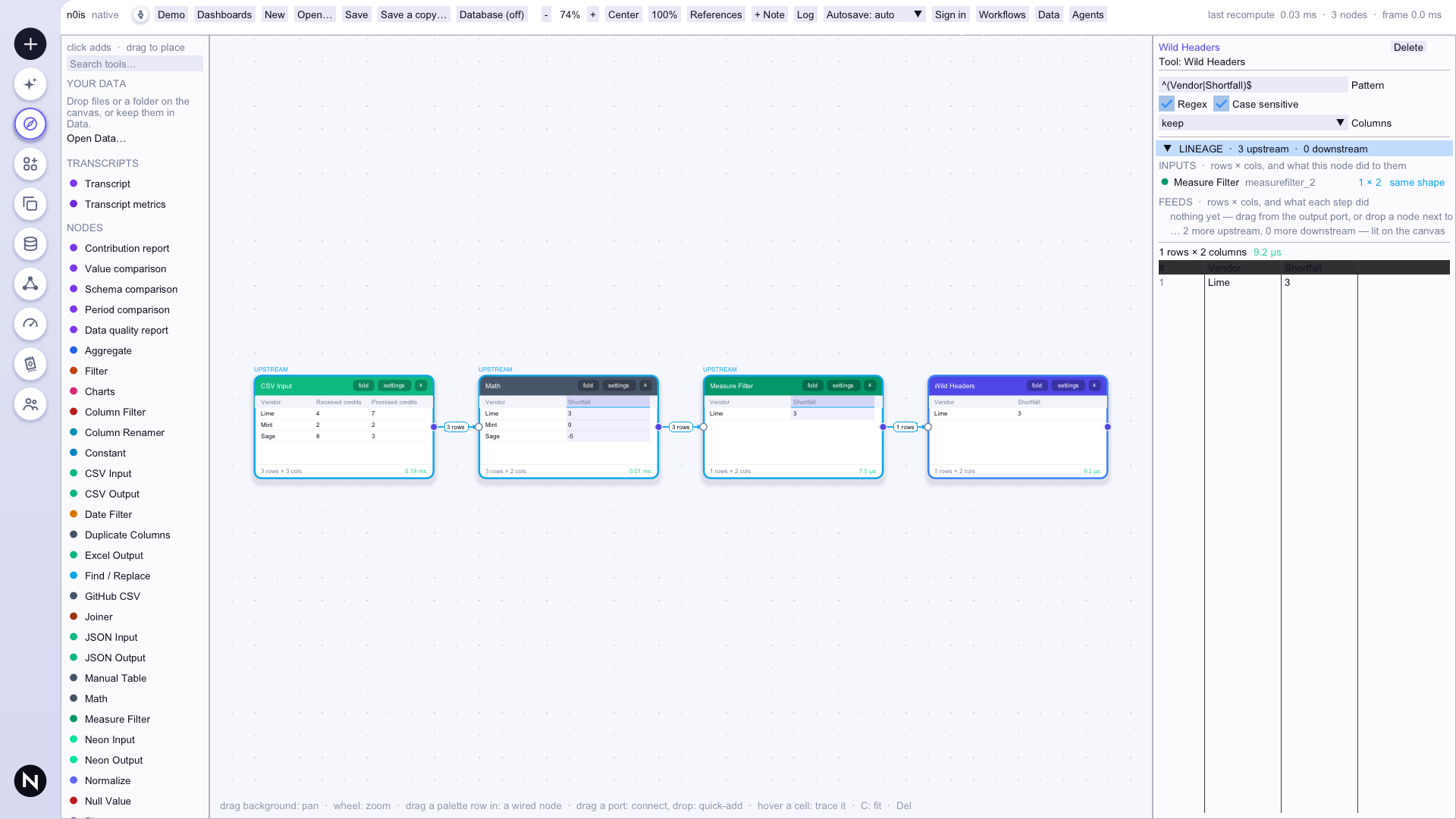
| Vendor | Shortfall |
|---|---|
| Lime | 3 |
How to use the result
For Vendor Lime, the sample reports Shortfall of 3.
Synthetic test audio. Screenshots from the recorded workflow in n0is.