Short shipment · choose field
Why ask this?
Before arranging the next shipment, a coordinator needs a list of orders to follow up with the shipping team. The remaining quantity tells the coordinator how much to follow up on.
Start with the sample data
Open source.csv. In the first row of source.csv, Order = A, Requested boxes = 8, Estimated shipped boxes = 9, Actual shipped boxes = 6.
What to say
List only the orders that shipped fewer boxes than requested. Subtract shipped boxes from requested boxes and show the shortfall.
Processing time
- Recorded audio to table ready
- 6.44 s
- Transcript to table ready
- 0.50 ms
One local replay from recorded audio through transcription and native table data preparation. Includes processing of the clarification and reply. Time waiting for a person to answer is excluded. Recording time and screen painting are excluded.
See the transcript in the composer

When n0is asks
Which delivered quantity should I subtract?
- Estimated shipped boxes
- Actual shipped boxes
Actual shipped boxes.
How the canvas produces the result
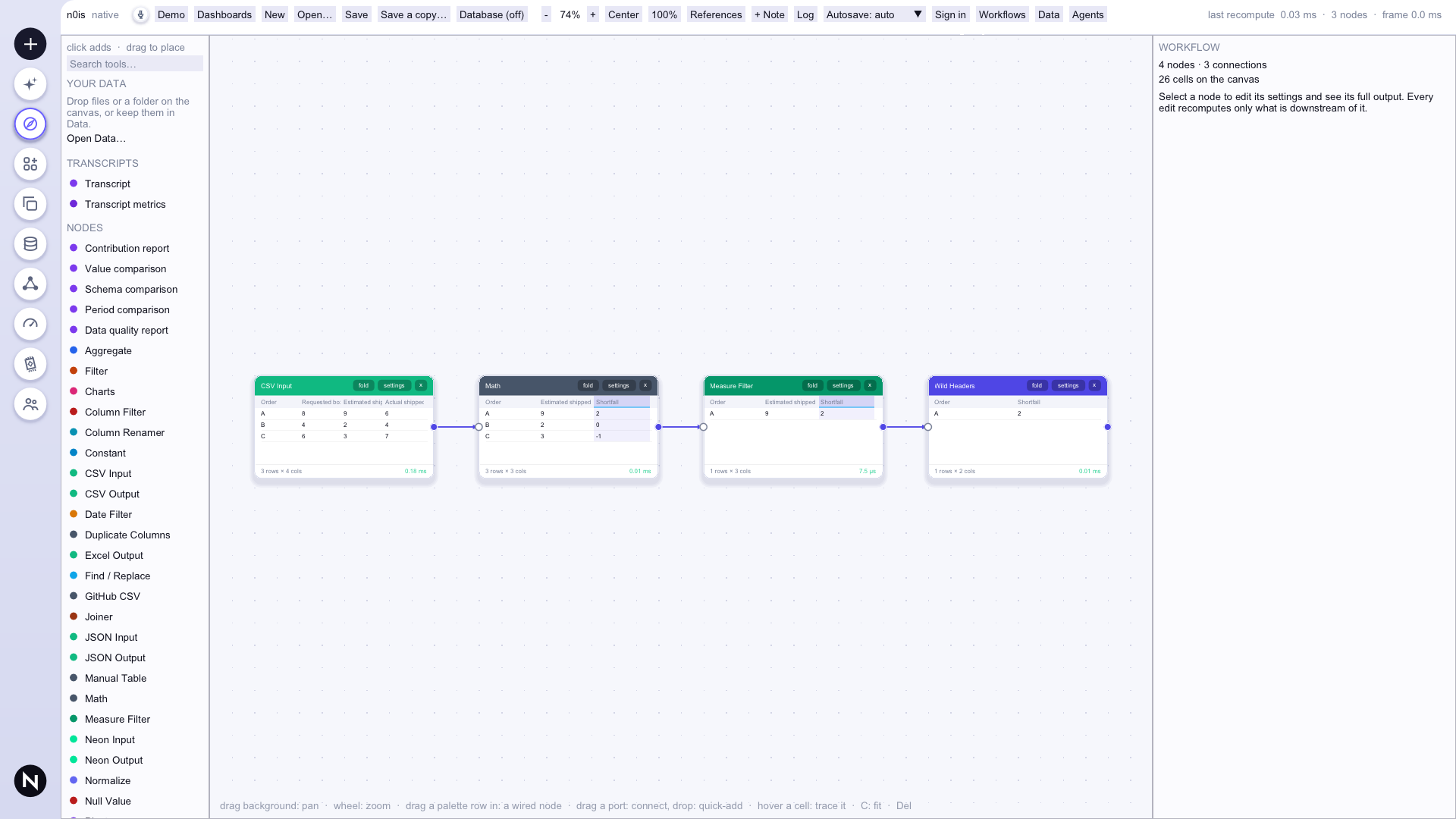
- CSV Input · Read the sample records
source.csv supplies 3 rows. These records are the inputs to the next step.
- Math · Calculate Shortfall
Apply [Requested boxes] - ([Actual shipped boxes]) to each input row. The first row yields 2.
- Measure Filter · Keep the requested rows
The filter uses Shortfall > 0 in keep mode. 1 rows remain including A.
- Wild Headers · Choose the output columns
Use keep mode with the regular expression ^(Order|Shortfall)$. The output contains Order, Shortfall.
The result table
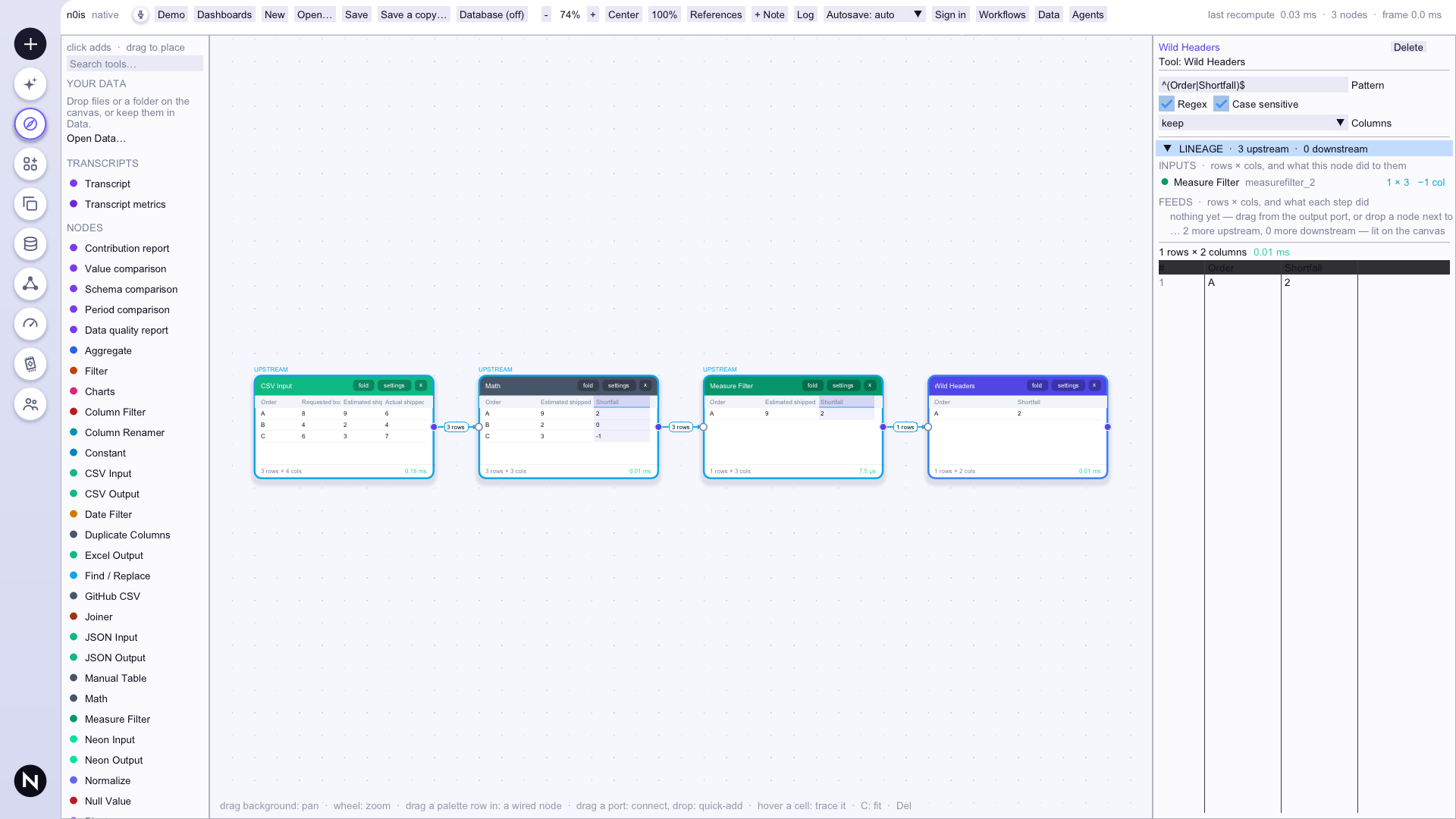
| Order | Shortfall |
|---|---|
| A | 2 |
How to use the result
For Order A, the sample reports Shortfall of 2.
Synthetic test audio. Screenshots from the recorded workflow in n0is.